
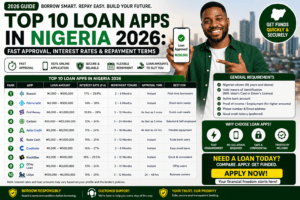
Getting an emergency loan in Nigeria has become considerably easier with digital lending apps. Instead of visiting a bank branch, completing lengthy forms or providing traditional collateral, eligible borrowers can now apply for personal loans directly from their smartphones.
Popular platforms such as FairMoney, Carbon, Branch, QuickCheck, Renmoney, Palmcredit and Kuda can assess applications digitally and, for approved borrowers, disburse money quickly.
However, convenience comes with an important warning: instant loans can be significantly more expensive than conventional bank loans, particularly when interest is charged monthly or daily.
Nigeria also strengthened the regulation of digital consumer lending. Under the Federal Competition and Consumer Protection Commission’s 2025 Digital, Electronic, Online or Non-Traditional Consumer Lending Regulations, digital lenders operating within Nigeria are required to be appropriately registered or licensed. Consumers also have formal avenues for complaints and redress. (FCCPC)
This guide compares 10 popular loan apps in Nigeria in 2026, including potential loan amounts, interest rates, repayment periods, approval speed, requirements and the important costs borrowers should check before accepting an offer.
Important: Loan limits and interest rates are personalized. Two people applying through the same app may receive completely different offers based on credit history, income, account activity, previous repayments and the lender’s risk assessment. Always rely on the final offer shown to you in the app before borrowing.
Quick Comparison: Best Loan Apps in Nigeria 2026
| Loan App | Potential Loan Amount | Published/Reported Pricing | Repayment | Best For |
|---|---|---|---|---|
| FairMoney | Up to ₦3 million* | Approx. 2.5%–30% monthly* | Varies | Larger digital loans |
| Carbon | ₦2,500–₦1 million | 4.5%–30% monthly | 61 days–12 months | Flexible personal loans |
| Branch | Up to ₦2 million* | Approx. 3%–19% monthly* | Varies | Repeat borrowers |
| QuickCheck | Up to around ₦500,000 | Personalized | Varies | Small urgent loans |
| Renmoney | Up to ₦6 million* | Approx. 2.5%–4% monthly* | Varies | Larger personal loans |
| Palmcredit | Up to around ₦800,000* | Approx. 4%–15% monthly* | Varies | Small/medium quick credit |
| Aella Credit | Personalized | Personalized | Varies | Unsecured credit |
| OKash | Personalized | Personalized | Short-term | Emergency borrowing |
| Umba | Personalized | Personalized | Varies | Digital banking + credit |
| Kuda Loan | Up to ₦150,000 | Offer-specific | 1–3 months | Existing Kuda users |
*Figures marked with an asterisk are current indicative figures reported in Kuda’s July 2026 comparison of popular Nigerian loan apps rather than universal guaranteed offers from the lender. (Kuda)
1. FairMoney
FairMoney is one of Nigeria’s most recognizable digital lenders and operates as a microfinance bank regulated by the Central Bank of Nigeria.
Its platform combines:
- Personal loans
- Bank accounts
- Transfers
- Bill payments
- Savings
- Credit facilities
FairMoney states that it is licensed by the CBN and that eligible deposits are insured by the Nigeria Deposit Insurance Corporation. (FairMoney)
How Much Can You Borrow?
A July 2026 comparison published by Kuda reports FairMoney loan limits of approximately:
₦1,500 – ₦3,000,000
depending on the borrower’s credit profile. (Kuda)
A first-time borrower should not expect to automatically receive ₦3 million.
Your initial offer could be considerably smaller.
Interest Rate
The same 2026 comparison reports potential FairMoney monthly rates of around:
2.5% – 30% per month
depending on the borrower. (Kuda)
This wide range demonstrates why borrowers should check the actual total repayment amount rather than assuming FairMoney has one fixed rate.
Approval
FairMoney uses digital credit assessment, meaning eligible users can receive loan decisions without traditional collateral.
Best For
FairMoney may be worth considering for:
- Borrowers seeking larger digital loan limits
- Existing FairMoney customers
- People who want lending and banking services in one app
2. Carbon
Carbon is one of the most transparent lenders in this comparison because it publicly publishes a detailed range for its personal loans.
Carbon currently states that personal loans range between:
₦2,500 and ₦1,000,000
with repayment periods from:
61 days to 12 months
and monthly interest rates between:
4.5% and 30%
depending on the customer’s profile. (Carbon)
Maximum APR
Carbon also publishes a maximum APR of:
195% per year
which demonstrates how expensive some short-term digital credit can become. (Carbon)
Carbon Loan Example
Carbon provides an example involving:
₦1,000,000 borrowed for 12 months
at:
4.5% monthly interest
with total repayment of:
₦1,540,000
and an APR of approximately:
54%.
(Carbon)
This is a useful example of why a seemingly small monthly percentage can become a substantial amount over a year.
Requirements
Carbon says borrowers do not need:
- Collateral
- Guarantors
- Long physical forms
A user must generally create and sufficiently verify a Carbon account before applying. Carbon says KYC Level 2 is required before accessing its loan facility. (Carbon)
Approval Speed
Carbon says loan decisions can be communicated within minutes after the application is completed. (Carbon)
Best For
Carbon may suit:
- Borrowers wanting transparent published terms
- People needing up to ₦1 million
- Borrowers requiring several months to repay
3. Branch
Branch is another established digital lender serving Nigerian consumers.
It provides unsecured personal credit, with the actual limit determined by the applicant’s financial profile and previous borrowing behaviour.
A July 2026 industry comparison by Kuda reports Branch loan amounts of approximately:
₦6,000 – ₦2,000,000
with monthly interest approximately:
3% – 19%
depending on the customer. (Kuda)
How Branch Determines Your Offer
Like most digital lenders, Branch may consider factors such as:
- Credit history
- Previous borrowing
- Repayment record
- Account or financial information
- Loan amount requested
A first-time borrower may initially receive a smaller credit limit.
Repaying responsibly can improve future offers.
Best For
Branch may appeal to:
- Borrowers who want collateral-free loans
- Repeat borrowers building a repayment history
- People wanting a fully digital application process
4. QuickCheck
QuickCheck is another popular Nigerian digital lending platform.
Its 2026 information says borrowers can apply without traditional collateral or paperwork and that qualifying applications can be processed rapidly.
QuickCheck currently advertises loans of approximately:
Up to ₦500,000
for qualifying borrowers in some of its 2026 materials. (QuickCheck)
Approval Speed
QuickCheck states that some approved borrowers can receive funds in approximately:
5 minutes
although approval time can vary based on verification and credit checks. (QuickCheck)
Interest Rate
QuickCheck emphasizes personalized pricing rather than presenting one universal rate.
Its 2026 guidance explains that Nigerian instant-loan apps broadly can charge anywhere from approximately:
2%–30% monthly
depending on creditworthiness, duration and lender. (QuickCheck)
The specific QuickCheck rate you receive should therefore be checked inside your loan offer.
Requirements
Applicants typically need to provide sufficient information for:
- Identity verification
- Credit assessment
- Contact details
- Bank/payment information
QuickCheck states that collateral is not required for its standard instant credit facility. (QuickCheck)
Best For
QuickCheck may be useful for:
- Small emergency loans
- Borrowers prioritizing quick processing
- Applicants who don’t have collateral
5. Renmoney
Renmoney is a CBN-regulated microfinance bank offering digital personal credit in Nigeria.
It differs from some very small instant-loan apps because it can potentially accommodate larger personal borrowing.
Kuda’s July 2026 comparison reports that Renmoney can offer loans of up to approximately:
₦6 million
with indicative monthly pricing around:
2.5%–4%
depending on eligibility. (Kuda)
Why Consider Renmoney?
Renmoney may be more suitable when you need:
- A larger loan
- Longer-term personal financing
- A regulated microfinance-bank lender
However, larger borrowing may involve more detailed affordability and documentation checks than a ₦10,000 emergency app loan.
Best For
Renmoney may suit:
- Salary earners
- Borrowers needing larger amounts
- Customers who prefer microfinance-bank lending
6. Palmcredit
Palmcredit is another well-known quick-credit app.
It is associated with Newedge Finance, which appears among lenders referenced in Nigeria’s regulated digital-lending ecosystem. QuickCheck’s 2026 regulatory guide identifies Newedge Finance’s Palmcredit and Newcredit products among FCCPC-approved digital lending services. (QuickCheck)
Kuda’s July 2026 comparison reports Palmcredit loan amounts of approximately:
₦10,000 – ₦800,000
with potential interest of around:
4%–15% monthly. (Kuda)
First-Time Borrowers
Your initial limit may be substantially lower than the maximum.
Digital lenders frequently increase limits after successful repayments.
Best For
Palmcredit may work for:
- Smaller emergency expenses
- Borrowers who need relatively quick credit
- Users who prefer mobile-only applications
7. Aella Credit
Aella Credit is another digital lending platform that has operated within Nigeria’s fintech market.
QuickCheck’s 2026 regulatory overview identifies Aella Financial Solutions/Aella Credit among lenders operating under the digital-lending regulatory framework. (QuickCheck)
Aella’s precise loan amount, rate and repayment term can depend on the individual applicant.
Instead of assuming a particular advertised percentage will apply to you, check the offer for:
- Principal
- Interest
- Service charges
- Due date
- Late-payment terms
- Total repayment
Best For
Aella may be worth comparing if you want:
- Collateral-free personal credit
- Digital application
- Personalized loan offers
8. OKash
OKash is another popular mobile lending service.
QuickCheck’s 2026 regulatory overview associates OKash with Blue Ridge Microfinance Bank, alongside EaseMoni. (QuickCheck)
The platform focuses heavily on short-term digital credit.
Why Be Careful With Short-Term Loans?
Short repayment periods can make even moderate interest rates expensive.
For example, borrowing:
₦100,000
and being required to repay:
₦120,000 after 30 days
means your financing cost is:
₦20,000
for only one month.
Repeated use of such credit can create a serious debt cycle.
Best For
OKash should generally be considered for:
- Short-term urgent expenses
- Borrowers who already know how they will repay
It should not be treated as free emergency money.
9. Umba
Umba combines digital financial services with access to credit.
It is particularly relevant for customers who prefer managing banking and borrowing through their smartphones.
Loan limits, interest and repayment schedules can be personalized according to the borrower’s profile.
Before accepting an Umba loan, compare:
- Amount received
- Total repayment
- Loan duration
- Fees
- Penalty terms
Best For
Umba may suit:
- Digital-first customers
- Borrowers comparing app-based banking and lending
- Applicants looking for personalized credit offers
10. Kuda Loan
Kuda is primarily known as a digital microfinance bank, but it also offers both personal loans and overdrafts.
Its standard personal loan currently provides eligible borrowers with up to:
₦150,000
and repayment periods between:
1 and 3 months. (Kuda)
How Fast Is Kuda?
Kuda says that once an application is approved, the loan can be paid into the customer’s Kuda account within minutes. (Kuda)
Collateral
Kuda says its standard personal loan does not require collateral. (Kuda)
Loan Requirements
Applicants need to pass Kuda’s automated eligibility checks.
Your offer depends on the assessment rather than simply requesting the maximum ₦150,000.
Kuda Overdraft: An Alternative to a Regular Loan
Kuda also has an overdraft facility.
Instead of receiving one fixed loan amount, eligible users can spend above their account balance up to an approved limit.
Kuda currently advertises daily overdraft interest broadly around:
0.23%–0.8% per day
on its product page. (Kuda)
Because interest is charged daily, borrowers should be extremely careful about holding an overdraft for long periods.
For example:
0.8% × 30 days = approximately 24%
before considering the specific calculation method.
A daily rate that looks small can therefore become expensive.
Which Loan App Gives the Highest Amount?
Among the indicative products compared above:
Renmoney
Up to approximately ₦6 million
FairMoney
Up to approximately ₦3 million
Branch
Up to approximately ₦2 million
Carbon
Up to ₦1 million
Palmcredit
Up to approximately ₦800,000
QuickCheck
Up to approximately ₦500,000
Kuda
Up to ₦150,000 on its standard personal-loan product
Remember that maximum advertised limits are not the same as the amount a first-time customer will receive. (Kuda)
Which Loan App Has the Lowest Interest Rate?
There isn’t one universal answer because lenders use personalized risk pricing.
Kuda’s July 2026 comparison reports approximate starting rates such as:
- FairMoney — from around 2.5% monthly
- Renmoney — from around 2.5% monthly
- Branch — from around 3% monthly
- Palmcredit — from around 4% monthly
- Carbon — from 4.5% monthly
(Kuda)
However, you may not qualify for the lowest advertised rate.
Someone with poor credit could receive a much more expensive offer.
Which Loan App Gives Money Fastest?
Many Nigerian loan apps advertise decisions or disbursement within minutes.
For example:
Carbon
Says borrowers can receive a decision within minutes. (Carbon)
QuickCheck
Advertises the possibility of receiving eligible loans in as little as approximately five minutes. (QuickCheck)
Kuda
Says approved personal loans are credited within minutes. (Kuda)
But “instant” does not mean guaranteed.
Applications can be delayed or rejected because of:
- Identity verification
- Poor credit history
- Existing debt
- Incorrect information
- Insufficient account activity
Requirements for Loan Apps in Nigeria
Exact requirements vary, but borrowers commonly need:
1. BVN
Your Bank Verification Number helps lenders verify your banking identity.
2. NIN
National identity information can also form part of digital KYC.
3. Nigerian Phone Number
The phone number is typically needed for registration and verification.
4. Bank Account
Most lenders need a Nigerian bank account for disbursement or repayment.
5. Debit Card
Some platforms require a debit card to set up automatic repayments.
6. Valid Identification
Depending on KYC level, you may need a government-issued ID.
7. Credit History
Lenders may obtain information from credit bureaus.
8. Income or Account Activity
Some apps examine transaction history or ask about income to assess affordability.
What Determines Your Loan Limit?
Loan apps generally use automated credit scoring.
Factors can include:
Repayment History
Paying previous loans on time may improve future limits.
Income
A person earning ₦500,000 monthly can generally support more borrowing than someone earning ₦50,000.
Existing Loans
Too many outstanding facilities can reduce your eligibility.
Credit Bureau Records
Defaults can affect future borrowing across multiple lenders.
Account Activity
Some lenders use banking transactions to assess affordability.
Carbon explicitly says its loan amount, duration and interest rate depend on the user’s information and current risk profile. (Carbon)
Understanding Loan App Interest Rates
This is one of the most important parts of borrowing.
Suppose an app says:
“Interest: 10%”
You need to know:
10% per what?
Is it:
- Per day?
- Per month?
- For the entire loan?
- Per year?
These are very different.
Monthly Interest Example
Suppose you borrow:
₦100,000
at:
10% per month
for:
3 months
If calculated simply on the original amount:
₦100,000 × 10% × 3 = ₦30,000
Total repayment:
₦130,000
Additional fees could make it higher.
What Is APR?
APR means:
Annual Percentage Rate
It expresses the cost of borrowing on an annualized basis.
For example, Carbon explicitly discloses that its maximum APR can reach 195% per annum even though monthly rates are listed between 4.5% and 30%. (Carbon)
APR makes it easier to understand how expensive repeated short-term borrowing can become.
Daily Interest Can Be Expensive Too
Kuda’s overdraft illustrates this.
A daily interest range such as:
0.23%–0.8%
sounds smaller than 10% monthly.
But at 0.8% for 30 days, the simple equivalent is roughly:
24%
for one month.
(Kuda)
Always compare costs on the same time basis.
Flat Interest vs Reducing Balance
Flat Interest
Interest is calculated on the original amount throughout the loan.
Example:
Loan = ₦500,000
Rate = 5% monthly
Tenor = 6 months
Approximate flat interest:
₦500,000 × 5% × 6 = ₦150,000
Total:
₦650,000
Reducing-Balance Interest
Interest is calculated on the outstanding balance.
As you repay principal, future interest is calculated on a smaller amount.
A 5% reducing-balance loan can therefore cost less than a 5% flat loan.
How to Compare Two Loan Apps Properly
Don’t simply compare:
App A = 5%
versus:
App B = 7%
Instead compare:
Amount You Receive
How much enters your account?
Total Repayment
How much will leave your pocket altogether?
Repayment Period
30 days or 12 months?
Fees
Are there:
- Processing fees?
- Management fees?
- Insurance charges?
- Debit-card charges?
Late Penalty
What happens if you’re one day late?
The total amount payable is often the most useful figure.
Are Loan Apps Safe in Nigeria?
Some are legitimate and regulated; others may not be.
The FCCPC maintains a public digital-money-lender registration framework, and Nigeria’s 2025 consumer lending regulations require digital lenders to be appropriately registered or licensed. (FCCPC)
Before downloading a loan app, check:
- Company name
- Regulatory status
- Official website
- Privacy policy
- App-store publisher
- Interest disclosure
- Customer-service details
Do not borrow simply because an advertisement says:
“CBN APPROVED.”
Verify the claim.
Your Rights as a Borrower
The FCCPC’s 2025 regulations strengthened consumer protections in digital lending.
Consumers affected by violations can seek redress through the Commission, while digital lenders that violate the regulations can face sanctions including fines, suspension or loss of approval. (FCCPC)
Borrowers should expect transparent information concerning the credit facility they are accepting.
Loan Apps and Your Contacts
Historically, some digital lenders became notorious for contacting borrowers’ friends, family and colleagues after missed repayments.
This is one reason it is important to use regulated lenders that follow consumer-protection and data-privacy requirements.
Do not give unnecessary permissions to an app simply because you urgently need money.
What Happens If You Don’t Repay?
Default can have serious consequences.
Depending on the lender, this can include:
- Late fees
- Additional interest
- Automatic debit attempts
- Credit bureau reporting
- Reduced future borrowing limits
- Collection activity
- Legal recovery in appropriate situations
For example, Carbon publishes a late fee of approximately 0.03333% per day on its personal-loan information. (Carbon)
Default should not be treated casually.
How to Improve Your Chances of Approval
Maintain a Good Credit History
Pay existing debts when due.
Provide Accurate Information
Do not inflate your salary or provide false employment information.
Avoid Multiple Applications at Once
Applying to numerous lenders simultaneously can signal financial pressure.
Keep Your Bank Account Active
Stable transaction history can help digital lenders assess your affordability.
Start Small
Successfully repaying a small loan can sometimes unlock larger limits.
Carbon explicitly says customers may unlock higher loan amounts and lower rates through good repayment behaviour and account usage. (Carbon)
Best Loan App for ₦10,000–₦50,000
For smaller emergency borrowing, options worth comparing include:
- QuickCheck
- Palmcredit
- Carbon
- Branch
- Kuda
QuickCheck specifically notes that several regulated apps provide loans in the ₦20,000–₦50,000 range for qualifying customers. (QuickCheck)
Best Loan App for ₦100,000+
Consider comparing:
- Carbon
- Branch
- FairMoney
- Renmoney
- Palmcredit
Your eligibility will determine which gives you the best offer.
Best Loan App for ₦1 Million+
Borrowers needing more than ₦1 million may find smaller instant-loan apps unsuitable.
Based on current indicative limits, larger-credit options worth investigating include:
FairMoney
Potentially up to ₦3 million.
Branch
Potentially up to ₦2 million.
Renmoney
Potentially up to ₦6 million.
(Kuda)
A traditional bank personal loan may also provide a cheaper alternative for qualified salary earners.
Loan Apps vs Bank Personal Loans
Loan apps generally win on:
- Speed
- Convenience
- Limited paperwork
- No collateral
Traditional banks can win on:
- Lower interest rates
- Larger loans
- Longer repayment terms
Someone who needs ₦2 million for one year should therefore compare bank financing before automatically accepting a high-rate instant loan.
When Should You Use a Loan App?
A digital loan can potentially make sense for:
- Genuine emergency
- Short cash-flow gap
- Medical expense
- School payment
- Essential business stock
provided you have a clear repayment plan.
When Should You Avoid a Loan App?
Think carefully before borrowing for:
- Gambling
- Betting
- Luxury shopping
- Unnecessary gadgets
- Parties
- Repaying another expensive loan
- Nonessential expenses
Taking one app loan to repay another can create a dangerous debt cycle.
Loan App Scams to Avoid
Watch for:
“Pay Before We Release Your Loan”
Be suspicious if an unknown lender requests an upfront transfer to a personal account.
Fake Apps
Fraudsters can imitate real financial companies.
Guaranteed Approval
No responsible lender can guarantee approval before assessing you.
OTP Requests
Never send your banking OTP or PIN to a supposed loan agent.
Fake Customer Service
Use the lender’s official app or website rather than random WhatsApp numbers.
Frequently Asked Questions
Which loan app is best in Nigeria in 2026?
There is no single best app for everyone. FairMoney and Renmoney may suit larger borrowing, Carbon provides relatively transparent published loan terms, QuickCheck focuses on fast digital credit, while Kuda can be convenient for existing customers.
Which loan app gives up to ₦1 million?
Carbon currently publishes personal-loan amounts of up to ₦1 million. (Carbon)
Which loan app can give more than ₦1 million?
Current 2026 indicative figures suggest FairMoney, Branch and Renmoney can offer qualifying borrowers more than ₦1 million. (Kuda)
How much can Kuda lend?
Kuda currently advertises standard personal loans of up to ₦150,000 for eligible borrowers. (Kuda)
How long can I repay Kuda?
Kuda’s standard personal loan has repayment periods of approximately one to three months, according to its current product page. (Kuda)
What is Carbon’s interest rate?
Carbon currently publishes monthly personal-loan rates of approximately 4.5%–30%, depending on the customer. (Carbon)
How long does Carbon allow for repayment?
Carbon currently publishes repayment periods of 61 days to 12 months. (Carbon)
Can I get a loan without collateral?
Yes. Several digital lenders, including Carbon and Kuda, explicitly offer qualifying personal loans without traditional collateral. (Carbon)
Can loan apps approve me instantly?
Some lenders provide decisions and disbursement within minutes, but approval is never guaranteed.
Does repaying early improve my loan limit?
Potentially. Carbon, for example, says good repayment behaviour can unlock higher limits and lower interest rates. (Carbon)
Final Thoughts
The best loan apps in Nigeria in 2026 provide a fast and convenient way to access emergency credit, but borrowers should never choose a lender based only on how quickly money arrives.
Popular platforms worth comparing include:
FairMoney, Carbon, Branch, QuickCheck, Renmoney, Palmcredit, Aella Credit, OKash, Umba and Kuda.
Carbon currently publishes perhaps the clearest personal-loan range among these options: ₦2,500–₦1 million, repayment from 61 days to 12 months and monthly rates from 4.5% to 30% depending on the borrower. (Carbon)
Kuda currently offers qualifying users personal loans up to ₦150,000 with repayment over one to three months, while its separate overdraft product charges interest daily. (Kuda)
For larger digital borrowing, current 2026 comparisons indicate that FairMoney, Branch and Renmoney may offer qualifying customers limits running into millions of naira. (Kuda)
Before accepting any loan, compare four things:
How much enters your account, how much you must repay, how long you have to repay it, and what happens if you’re late.
Most importantly, check that the lender is appropriately regulated and read the final loan agreement before accepting the money. Nigeria’s current consumer-lending rules require digital lenders to operate within the applicable regulatory framework and provide consumers with avenues for redress. (FCCPC)
Disclaimer: This article is for general educational purposes and is not financial advice or an endorsement of any lender. Loan limits, approval times, interest rates, APRs and repayment terms can change and may differ for each applicant. Confirm the current offer directly inside the lender’s official app before borrowing.

