
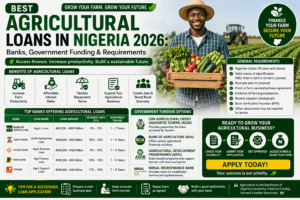
Agriculture remains one of Nigeria’s most important industries, but one of the biggest challenges facing farmers and agribusiness owners is access to affordable finance.
Farmers often need money for:
- Seeds
- Fertilizer
- Farm machinery
- Irrigation
- Poultry
- Fish farming
- Livestock
- Land preparation
- Storage
- Processing equipment
- Transportation
- Working capital
- Expansion
In 2026, Nigerian farmers can access agricultural financing through Bank of Agriculture, commercial banks, Bank of Industry, NIRSAL-supported lending structures and government-backed agricultural credit schemes.
However, it is important to understand that not every program advertised online is currently open, and not every government-backed agricultural financing initiative is a free grant.
For example, the Bank of Agriculture warned on 2 February 2026 that applications for the Renewed Hope National Agricultural Mechanization Program and related opportunities circulating online had already closed, and that applicants should rely only on official BOA announcements. (Agri-Business Bank)
This guide explains the major agricultural loan options available in Nigeria in 2026, how they work, typical requirements and what farmers should consider before borrowing.
Quick Comparison of Agricultural Finance Options in Nigeria
| Financing Option | Best For | Funding Type |
|---|---|---|
| Bank of Agriculture | Farmers, cooperatives, agribusinesses | Direct agricultural loans |
| NIRSAL-Supported Finance | Agribusinesses and value-chain operators | Bank loans backed by guarantees |
| Agricultural Credit Guarantee Scheme Fund | Farmers and agricultural businesses | Bank lending with government guarantee |
| Bank of Industry | Agro-processing and agricultural SMEs | Development finance |
| Commercial Bank Agric Loans | Established farmers and agribusinesses | Commercial credit |
| Cooperative Agricultural Loans | Smallholder farmers | Group-based financing |
| State Agricultural Programs | Farmers within participating states | Loans/subsidized support |
| Women & Youth Agriculture Finance | Young and female entrepreneurs | Targeted financing |
1. Bank of Agriculture Loans
The Bank of Agriculture (BOA) is one of the most important institutions for agricultural financing in Nigeria.
Its mandate includes providing credit to agricultural and rural businesses.
BOA currently states that its loan products are available to:
- Individuals
- Farmers
- Women
- Youth
- SMEs
- Cooperatives
- Corporate organisations
BOA says it has supported more than 2 million farmers and disbursed more than ₦250 billion in loans over time. (Agri-Business Bank)
Types of BOA Financing
Current BOA products include:
Micro Credit
Designed for individuals, groups and micro-enterprises requiring smaller amounts of financing.
Corporate Loans
Suitable for larger agricultural businesses, cooperatives and organisations.
Women and Youth Loans
Targeted toward young entrepreneurs and women engaged in agriculture and other businesses.
Nano Loans
Small short-term loans for immediate financing needs.
Commercial Agricultural Finance
Designed for businesses requiring larger facilities for production, processing or expansion.
What Can a BOA Agricultural Loan Be Used For?
Depending on the product, borrowers may potentially finance:
- Crop farming
- Poultry
- Fisheries
- Livestock
- Irrigation
- Agricultural processing
- Farm machinery
- Inputs
- Storage
- Distribution
- Agro-services
BOA’s mandate covers agricultural value-chain activities rather than only primary farming. (Agri-Business Bank)
Who Can Apply for Bank of Agriculture Loans?
Eligibility depends on the particular facility, but potential borrowers include:
- Individual farmers
- Farmer groups
- Registered cooperatives
- Agricultural SMEs
- Women entrepreneurs
- Young farmers
- Agribusiness companies
Applicants should expect BOA to evaluate whether the project is genuine and capable of repaying the loan.
Typical BOA Loan Requirements
Requirements can vary, but applicants should normally prepare:
- Valid identification
- BVN
- NIN
- Passport photographs
- Business or farm address
- Bank account
- Farm records
- Business registration for companies
- CAC documents where applicable
- Farm ownership or lease evidence
- Business plan
- Cash-flow projection
- Guarantor or security where required
- Cooperative documents for group loans
The exact requirements depend on the size and type of loan.
2. NIRSAL-Supported Agricultural Financing
NIRSAL is frequently misunderstood.
NIRSAL does not directly give loans to farmers.
NIRSAL itself states clearly that it is not a bank or direct lender. Instead, it works with banks and other financial institutions to reduce the risk of lending to agriculture. (NIRSAL)
NIRSAL stands for:
Nigeria Incentive-Based Risk Sharing System for Agricultural Lending
Its role is to make agricultural lending more attractive to financial institutions.
How NIRSAL Helps Farmers Get Loans
NIRSAL provides a Credit Risk Guarantee, or CRG.
This guarantee can cover up to:
75% of principal and accrued interest
depending on the product and transaction. (NIRSAL)
That means a participating bank may be more willing to finance an agricultural business because a significant portion of the lending risk is covered.
Who Can Benefit From NIRSAL-Backed Financing?
NIRSAL currently supports value-chain participants such as:
- Crop farmers
- Livestock producers
- Cooperatives
- Processors
- Input suppliers
- Mechanization businesses
- Warehousing companies
- Logistics businesses
- Agro-commodity traders
- Exporters
(NIRSAL)
This makes NIRSAL financing relevant beyond traditional farming.
NIRSAL Credit Guarantee Products
Single Obligor Guarantee
Designed for one specific agribusiness or agricultural project.
NIRSAL states that this product can cover:
Up to 75% of principal and interest. (NIRSAL)
It can support activities such as:
- Production
- Processing
- Logistics
- Trading
- Exporting
Portfolio Guarantee
Designed for lenders providing loans to several agricultural SMEs.
Instead of guaranteeing one borrower individually, NIRSAL can support a portfolio of qualifying agribusiness loans.
Green Guarantee
This supports environmentally sustainable agriculture.
Potential uses include:
- Solar-powered irrigation
- Renewable-energy systems
- Climate-smart agriculture
- Organic farming
- Sustainable logistics
NIRSAL says the Green Guarantee can include performance-based interest rebates. (NIRSAL)
Does NIRSAL Give Farmers Cash Directly?
No.
This is worth repeating because many online advertisements are misleading.
NIRSAL states:
It is not a lender.
Instead, it works with banks, microfinance banks, development finance institutions and other financiers. (NIRSAL)
The practical process may look like:
Farmer/Agribusiness → Participating Bank → Loan Assessment → NIRSAL Guarantee → Bank Disbursement
NIRSAL’s Agricultural Financing Impact
NIRSAL currently reports that it has facilitated more than:
₦383 billion
in financing to Nigerian agriculture and agribusinesses. (NIRSAL)
It also reported that more than ₦100 billion in agricultural loans and investments were covered through its guarantees during 2025 alone. (NIRSAL)
This makes it one of the most significant agricultural-finance support institutions in Nigeria.
3. Agricultural Credit Guarantee Scheme Fund
Another major agricultural-financing mechanism is the Agricultural Credit Guarantee Scheme Fund, commonly known as:
ACGSF
The scheme is backed through Nigeria’s financial system and is designed to encourage banks to lend to agricultural businesses by providing a guarantee against part of the lending risk.
What Can ACGSF Loans Finance?
Qualifying agricultural activities can include:
- Crop farming
- Livestock
- Poultry
- Fisheries
- Farm machinery
- Agricultural processing
- Storage
- Marketing
- Other qualifying agricultural activities
The actual financing comes from participating banks rather than from the farmer applying directly to the Central Bank.
ACGSF Loan Application Process
According to the scheme’s published guidelines:
- The farmer applies through a participating lending bank.
- The borrower opens the appropriate account.
- The ACGSF application form is completed.
- The bank assesses the borrower.
- Credit Bureau and Credit Risk Management System checks are conducted.
- Farm/project verification can take place.
- The bank forwards the qualifying guarantee application to the Central Bank.
Does ACGSF Require Collateral?
It depends on the amount and lender.
The published guidelines state that for certain smaller loans—historically ₦100,000 or below under those guidelines—banks were not expected to demand tangible security or feasibility reports, although group guarantees or other acceptable guarantees could still be required. (Central Bank of Nigeria)
For larger modern agricultural loans, borrowers should expect more detailed security and credit requirements.
Agricultural Insurance Requirement
The ACGSF guidelines require loans under the scheme to be insured before the guarantee takes effect. (Central Bank of Nigeria)
Agricultural insurance can protect against risks such as:
- Flooding
- Fire
- Disease
- Livestock mortality
- Crop losses
- Weather events
depending on the policy.
4. Bank of Industry Agricultural Finance
The Bank of Industry (BOI) is primarily focused on industrial and enterprise development, but it also finances parts of the agricultural value chain.
BOI currently maintains an agriculture sector portfolio and agricultural-focused products. (Boi.ng)
One current BOI product is the:
Smallholder Farmer Cluster
which is aimed at supporting agricultural production through organized farmer clusters. (Boi.ng)
Who Should Consider BOI?
BOI may be especially relevant for businesses involved in:
- Food processing
- Agro-processing
- Packaging
- Storage
- Agricultural manufacturing
- Agricultural equipment
- Value addition
For example, someone simply farming cassava may look first at BOA or an agricultural commercial-bank facility.
But someone operating a cassava-processing factory may find BOI particularly relevant.
BOI Requirements
Development finance institutions typically require stronger documentation than quick digital lenders.
Applicants may need:
- CAC registration
- Business plan
- Financial projections
- Bank statements
- Management information
- Equipment quotations
- Proof of business location
- Tax documents
- Security
- Equity contribution where applicable
Exact requirements vary by product.
5. Commercial Bank Agricultural Loans
Nigeria’s commercial banks also finance agriculture.
Potential borrowers include:
- Commercial farmers
- Poultry businesses
- Fisheries
- Agricultural processors
- Commodity traders
- Exporters
- Distributors
- Input suppliers
Banks can provide:
- Working capital
- Asset finance
- Overdrafts
- Equipment finance
- Term loans
- Trade finance
Advantages of Commercial Bank Agric Loans
Commercial banks may offer:
- Larger loan amounts
- Faster processing for established customers
- Structured repayment
- Trade facilities
- Export finance
However, commercial rates can be higher than government-supported development finance.
What Banks Look For
Commercial lenders typically examine:
Cash Flow
Can the farm realistically repay the loan?
Credit History
Does the applicant have unpaid debts or defaults?
Market
Who will buy the produce?
Experience
Does the borrower understand the business?
Collateral
What security is available?
Insurance
Is the agricultural risk insured?
6. Cooperative Agricultural Loans
Joining a registered farmers’ cooperative can significantly improve access to agricultural finance.
Banks and government programs often prefer organized farmer groups because they are easier to verify and monitor.
Cooperatives can also provide:
- Group guarantees
- Bulk input purchasing
- Shared machinery
- Off-take arrangements
- Better market access
NIRSAL specifically identifies cooperatives and smallholder clusters as potential beneficiaries of guaranteed agricultural lending. (NIRSAL)
7. Women and Youth Agricultural Loans
Women and young entrepreneurs can also access targeted agricultural financing.
Bank of Agriculture currently advertises a dedicated:
Women and Youth Loan
designed to support entrepreneurship, business growth and sustainable livelihoods. (Agri-Business Bank)
Eligibility and funding limits depend on the specific program.
Young farmers should prepare the same professional documentation as any other borrower rather than assuming youth programs are automatic grants.
8. Government Agricultural Funding
Federal and state governments periodically announce:
- Agricultural intervention funds
- Mechanization schemes
- Input finance
- Youth agriculture programs
- Cooperative funding
- Matching funds
- Grants
- Subsidized loans
However, these programs are often temporary.
One of the biggest mistakes applicants make is following an article published months or years earlier and assuming applications are still open.
Example: Renewed Hope Mechanization Program
In February 2026, the Bank of Agriculture issued a public warning about online posts claiming applications were still open for the Renewed Hope National Agricultural Mechanization Program.
BOA confirmed that:
- The program itself is genuine.
- It is not a free program.
- Applicants must meet financial obligations.
- Applications had already closed.
- Only official BOA channels should be trusted.
This demonstrates why farmers should always verify application dates.
Best Agricultural Loan for Small Farmers
For smallholder farmers, useful places to investigate include:
Bank of Agriculture Micro Credit
Suitable for smaller agricultural businesses.
Cooperative Loans
Useful for people who lack substantial collateral.
Bank of Industry Smallholder Farmer Cluster
Potentially useful where farmers operate within organized agricultural clusters. (Boi.ng)
Bank Loans Backed by NIRSAL
Can potentially reduce lender risk and improve access to credit.
Best Agricultural Loan for Large Agribusiness
Larger businesses should consider:
- BOA Corporate Loans
- Commercial-bank agricultural loans
- BOI finance
- NIRSAL-guaranteed facilities
NIRSAL’s Single Obligor Guarantee is specifically designed for larger identifiable agribusiness projects and can cover up to 75% of qualifying lender exposure. (NIRSAL)
Best Loan for Agro-Processing
For processing businesses, compare:
Bank of Industry
because BOI focuses on industrial and value-added businesses.
Bank of Agriculture
because its mandate covers the wider agricultural value chain.
NIRSAL-Backed Commercial Finance
because NIRSAL supports processors and agribusiness SMEs. (NIRSAL)
Agricultural Loan Interest Rates in Nigeria
There is no single agricultural loan interest rate.
Rates depend on:
- Bank
- Program
- Guarantee
- Government subsidy
- Loan size
- Tenor
- Borrower’s creditworthiness
- Collateral
- Agricultural value chain
Government-supported loans may offer more favourable terms than ordinary commercial lending.
NIRSAL also states that some of its financing frameworks use donor funds and interest-drawback mechanisms to reduce borrowers’ effective interest burden. (NIRSAL)
What Is an Interest Drawback?
An interest drawback is effectively a rebate.
For example, a borrower might initially pay the lender’s agreed interest rate.
If the borrower complies with the loan terms and qualifies under an incentive program, part of the interest may later be refunded.
NIRSAL’s Green Guarantee includes a performance-based interest rebate for qualifying sustainable agricultural investments. (NIRSAL)
Requirements for Agricultural Loans in Nigeria
Requirements differ, but most serious agricultural lenders will expect some combination of:
BVN
Used to verify identity and banking history.
NIN
May be required for identity verification.
Valid ID
Examples include:
- National ID
- Driver’s licence
- International passport
- Voter’s card
Bank Account
The lender will typically require an active account.
Business Registration
Larger agribusinesses may need CAC registration.
Farm Evidence
This could include:
- Land ownership
- Lease agreement
- Farm photographs
- Location coordinates
- Farm inspection
Business Plan
Especially important for larger loan amounts.
Cash-Flow Projection
Shows how the project will generate enough money to repay the loan.
Market / Off-Taker Agreement
Farmers with confirmed buyers may appear less risky.
Collateral
Can be required for larger facilities.
Insurance
Particularly relevant for agricultural lending.
Why a Business Plan Matters
Many farmers approach lenders with statements such as:
“I need ₦10 million to start poultry farming.”
That is not enough.
A serious business plan should explain:
- Number of birds
- Cost of chicks
- Feed cost
- Housing
- Vaccination
- Labour
- Mortality assumptions
- Selling price
- Expected revenue
- Repayment schedule
Banks want evidence that the business can repay the loan.
Example: Poultry Loan Proposal
Suppose you want financing for:
5,000 broilers
Your proposal should calculate:
- Cost of chicks
- Feed
- Medication
- Housing
- Staff
- Electricity
- Transportation
- Expected mortality
- Expected selling weight
- Selling price
- Profit
- Loan repayment
This is far stronger than simply asking for money.
Agricultural Loans Without Collateral
Some small agricultural facilities can be provided without traditional land or property collateral.
Alternatives may include:
- Cooperative guarantees
- Personal guarantees
- Movable assets
- Warehouse receipts
- Off-take agreements
- Credit guarantees
However:
“No collateral” does not mean automatic approval.
The lender still needs confidence that the loan will be repaid.
How NIRSAL Can Reduce Collateral Pressure
NIRSAL’s guarantee protects part of the lender’s exposure.
This does not necessarily eliminate collateral requirements entirely, because NIRSAL states that partner banks still retain their own credit processes. (NIRSAL)
But it can reduce the perceived risk of agricultural lending.
How Much Agricultural Loan Can You Get?
There is no universal limit.
A farmer might receive:
₦100,000–₦1 million
for small production.
A commercial farmer may obtain:
Several million naira.
A processor or corporate agribusiness may potentially secure:
Tens or hundreds of millions of naira
subject to the financial strength and project.
Loan size is usually based on what the business can realistically repay.
Loan Tenor
Agricultural repayment periods should ideally match the production cycle.
For example:
Poultry
Shorter cycle.
Maize
Seasonal cycle.
Cassava
Longer production cycle.
Orchard
Long-term investment.
Processing plant
Several years may be necessary.
A good lender should structure repayment to reflect how the agricultural business generates cash.
How to Increase Your Chances of Approval
Keep Financial Records
Record:
- Sales
- Expenses
- Farm inputs
- Production
- Profit
Use a Business Bank Account
Avoid mixing personal and business money where possible.
Join a Cooperative
Group structures can improve access to some schemes.
Obtain Agricultural Insurance
This reduces risk.
Secure Buyers
Off-take agreements can strengthen applications.
Start Small and Build Credit
Successfully repaying smaller loans can help establish creditworthiness.
Register Your Business
Formalization can make larger financing easier.
Agricultural Loan Application Process
A typical process looks like:
Step 1: Identify the Right Loan
Determine whether you need:
- Working capital
- Machinery
- Inputs
- Processing finance
- Expansion finance
Step 2: Prepare Documentation
Gather:
- ID
- BVN
- Business records
- Farm documents
- Business plan
Step 3: Apply
Use the official bank or institution.
Step 4: Credit Assessment
The lender checks:
- Credit history
- Cash flow
- Farm viability
- Security
Step 5: Farm Inspection
The lender may visit the project.
Step 6: Approval
If approved, you’ll receive loan terms.
Step 7: Review the Agreement
Check:
- Interest
- Fees
- Repayment
- Penalties
- Insurance
Step 8: Disbursement
Funds may be paid directly to you or sometimes to suppliers depending on the financing structure.
Agricultural Loan Scams to Avoid
Agriculture funding scams are common.
Be cautious of messages saying:
“Federal Government Agricultural Grant 2026 — ₦5 Million for Every Farmer — Pay ₦10,000 Processing Fee.”
Common warning signs include:
Guaranteed Government Grant
Real programs have eligibility requirements.
Random Registration Links
BOA has specifically warned Nigerians about unverified links claiming to offer agricultural programs. (Agri-Business Bank)
Payment to Personal Accounts
Government banks do not normally ask applicants to send application fees to an individual’s private account.
Fake NIRSAL Loans
NIRSAL does not directly give loans to farmers. (NIRSAL)
Fake Approval Letters
Verify the loan directly with the institution.
Frequently Asked Questions
What is the best agricultural loan in Nigeria in 2026?
There is no single best product. Bank of Agriculture is a strong starting point for farmers, while BOI may be more suitable for agro-processors. Larger agribusinesses should also investigate NIRSAL-backed financing through partner banks.
Does Bank of Agriculture give loans?
Yes. BOA currently offers credit to individuals, farmers, women, youth, SMEs, cooperatives and corporate organisations. (Agri-Business Bank)
Does NIRSAL give agricultural loans directly?
No. NIRSAL explicitly states that it is not a bank or lender. It provides credit guarantees and helps connect agribusinesses to financial institutions. (NIRSAL)
How much does NIRSAL guarantee?
Its current Credit Risk Guarantee can provide up to 75% coverage of principal and accrued interest, depending on the product. (NIRSAL)
Can farmers get loans without collateral?
Some smaller or group facilities can use alternative forms of security, but requirements depend on the bank and loan amount.
Does CBN give agricultural loans directly to individuals?
Many CBN-supported agricultural interventions operate through participating financial institutions rather than people walking into the Central Bank to receive cash.
Can a cooperative apply for agricultural finance?
Yes. BOA and NIRSAL-supported frameworks both recognize cooperatives and farmer groups as potential beneficiaries. (Agri-Business Bank)
Are agricultural grants free?
Not every program advertised as a government opportunity is a grant. For example, BOA explicitly warned in February 2026 that the Renewed Hope mechanization program was not free and that applications had already closed. (Agri-Business Bank)
Final Thoughts
The best agricultural loans in Nigeria in 2026 depend largely on the type and size of your agricultural business.
For small and medium farmers, the Bank of Agriculture remains one of the most important institutions to investigate. BOA currently offers loan facilities to farmers, women, youth, SMEs, cooperatives and corporate organisations. (Agri-Business Bank)
For agribusinesses that struggle to obtain conventional bank credit, NIRSAL-backed financing can also be valuable. NIRSAL does not lend directly, but its Credit Risk Guarantee can cover up to 75% of principal and accrued interest, helping financial institutions lend more confidently to agriculture. (NIRSAL)
For agricultural processors and value-added businesses, the Bank of Industry is another institution worth investigating, while the Agricultural Credit Guarantee Scheme Fund can help qualifying borrowers access bank financing through government-backed guarantees.
Before applying, prepare:
- A clear business plan
- Accurate financial records
- Farm or business documentation
- BVN and identification
- Evidence of market demand
- Realistic cash-flow projections
Most importantly, apply only through official institutions and verify that a program is currently open. BOA’s February 2026 warning about false agricultural funding announcements shows how easily outdated or fraudulent opportunities can spread online. (Agri-Business Bank)
Disclaimer: This article provides general financial information and is not financial advice or a guarantee of funding. Loan rates, eligibility rules, collateral requirements and government programs can change. Verify current terms directly with the Bank of Agriculture, Bank of Industry, NIRSAL, participating commercial banks and relevant government agencies before applying.